





























Why Companies Need to Adopt RFID Now
The case for RAIN RFID and 2D barcode investment ahead of the Sunrise 2027 deadline
Executive Summary
The way the world identifies, tracks, and authenticates products is being rebuilt. Two forces are converging at once: the global retail and healthcare transition to 2D barcodes under GS1’s Sunrise 2027 initiative, and the accelerating shift to RAIN (UHF) RFID for item-level visibility. Companies that treat these as a future compliance chore will be reacting under deadline pressure. Companies that act now will turn the same investment into faster operations, lower shrink, and a data foundation their competitors won’t have.
This business case lays out why the window to adopt is open today, what the cost of waiting is, and how TSC Auto ID — together with the labeling and consumables manufacturing of TSC Genuine Supplies and the enterprise mobility portfolio of Bluebird, both TSC Auto ID Companies — gives organizations a single, scalable partner to make the transition with confidence.
The Market Has Already Decided
RFID is no longer emerging — it is scaling
- ~55 billion passive RFID tags were sold in 2025, up from 50 billion in 2024 — roughly 10% year-over-year growth, driven overwhelmingly by passive UHF (RAIN) labels.
- Retail apparel alone is expected to consume over 31 billion RFID tags in a single year, yet RFID still covers only about 40% of that addressable market — meaning the steepest growth is still ahead.
- 115 billion: UHF RAIN chip volume is projected to reach roughly 115 billion shipped chips by 2028, expanding at about 20% per year as tagging spreads into healthcare, pharmaceuticals, manufacturing, automotive, tires and many other industries.
- $14B by 2031: The broader UHF RFID (RAIN) market is forecast to grow from about $4.6 billion in 2024 toward $14 billion by 2031 — a high-teens compound annual growth rate.
Takeaway: the largest players in retail and the standards bodies behind them have already committed. Adoption curves like this reward early, conscientious movers and penalize laggards, who rush deployments later.
Sunrise 2027: A De Facto Requirement, Not a Suggestion
GS1’s Sunrise 2027 initiative commits the retail industry to having point-of-sale systems capable of reading 2D barcodes — QR codes and GS1 DataMatrix — by the end of 2027. The same shift is underway in healthcare for point-of-care scanning. Pilots already span dozens of countries representing the overwhelming majority of global GDP, and a strong majority of retail POS systems can already read 2D codes.
The traditional 1D UPC barcode will not be prohibited, but it will no longer be enough. A single 2D symbol can carry additional item information such as a batch / lot number, expiration date, serial number, and a direct link to digital content for detailed item information like recycling and disposal instructions, sustainability score, assembly instructions, etc. — essentially unlimited information — where a UPC carries a single number identifying the product type. For regulated industries and consumer transparency demands, that difference is decisive.
Why this drives RFID, not just barcodes
The 2D transition and RFID are complementary, not competing. When a product’s 2D barcode is paired with an encoded RAIN RFID tag, organizations gain both consumer-facing engagement and warehouse-scale, no-line-of-sight inventory visibility. Standards bodies expect the 2D rollout to pull RFID into categories — such as perishable food — that are not yet widely tagged. Preparing for one without the other leaves value on the table.
The Cost of Waiting
| Decision Area | Adopt Now | Wait Until Mandated |
|---|---|---|
| Hardware & tag pricing | Lock in supply and plan rollouts at stable cost | Compete for constrained supply at peak demand |
| Deployment quality | Phased pilots, trained staff, tuned read rates | Rushed, deadline-driven installs and rework |
| Data advantage | Years of inventory and traceability data compounding | Starting from zero while peers operate on insight |
| Customer & partner trust | Meet retailer mandates ahead of schedule | Risk of de-listing or chargebacks for non-compliance |
The Business Returns
What RFID delivers across the operation
- Inventory accuracy: RFID inventory counts reach near-perfect accuracy versus the 60–80% typical of manual systems — the foundation for reliable omnichannel fulfillment.
- Labor efficiency: No line-of-sight reads let staff count entire pallets or racks in seconds, redirecting labor from counting to selling and serving.
- Loss prevention: Item-level visibility cuts out-of-stocks and reduces both theft and administrative shrink.
- Traceability: Batch, lot, and expiration tracking supports faster recalls and regulatory compliance in healthcare, pharma, and food.
- Data for AI: RFID read data feeds demand forecasting and AI-driven planning, reducing waste and markdowns.
Why TSC Auto ID, TSC Genuine Supplies, and Bluebird
Most organizations don’t want to assemble a transition from a dozen vendors. The TSC Auto ID group brings the full chain — encoding, printing, labels and media, reading, and mobility — under one trusted partner serving 100+ countries.
TSC Auto ID — the encoding and printing backbone
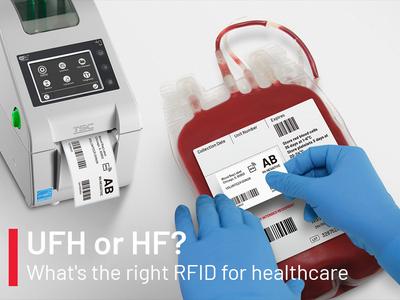
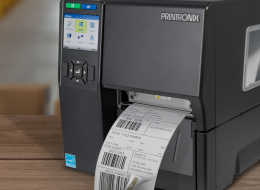
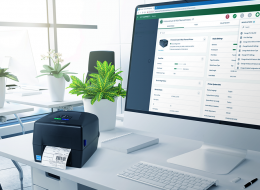
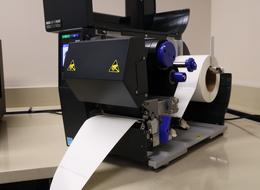
- RFID-capable thermal printers that encode and verify RAIN tags inline while printing the 2D barcode — one device, both technologies.
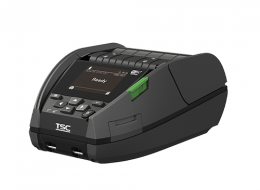
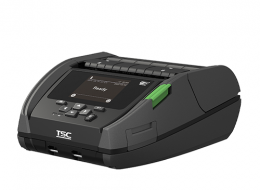
- A broad printer portfolio from desktop to industrial, matched and tested with TSC Genuine Supplies media for reliable encode and read performance.
- Broad command-language compatibility (ZPL, EPL, DPL, TSPL) for integration into existing systems without rip-and-replace.
TSC Genuine Supplies — the label and RFID media engine
- A leading North American manufacturer of pressure-sensitive labels and printer consumables, producing RFID labels and tags, blank and full-color labels, linerless solutions, and thermal transfer ribbons.
- In-house RFID inlay insertion and converting — wet and dry inlays — for consistent encode quality and a simplified, single-source supply chain.
- Nationwide production and distribution facilities with a channel-focused model, giving partners fast lead times and scalable volume for high-tag-count rollouts.
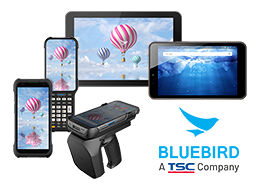
Bluebird, a TSC Auto ID Company — the capture and mobility layer
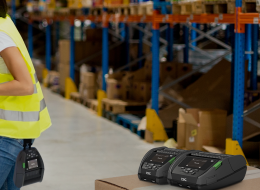
- Rugged enterprise mobile computers and RFID sled readers for receiving, cycle counts, and store or floor operations.
- Fixed readers and antennas for always-on deployments.
- Devices built to read both 2D barcodes and RAIN RFID, so frontline teams carry one tool for the full transition.
- Enterprise-grade durability and manageability for retail, logistics, healthcare, and manufacturing environments.
Together: TSC Auto ID, TSC Genuine Supplies, and Bluebird cover the workflow end to end — from label and RFID media manufacturing, through tag encoding and printing, to data capture and verification — a single, scalable, accountable partner for the Sunrise 2027 and RFID transition.
Recommendation
The market, standards bodies, and the largest retail and healthcare buyers have already moved. The question is no longer whether to adopt RFID and 2D barcodes, but whether to do it on your own timeline or under someone else’s deadline. We recommend a phased program beginning now:
- Assess — map current labeling, scanning, and inventory workflows against Sunrise 2027 requirements.
- Pilot — deploy a TSC 2D and RFID printing program on TSC Genuine Supplies RFID media with Bluebird data capture in one high-value category or site.
- Scale — expand on proven read rates and ROI, with localization and rollout support across regions.
Adopt now, lead later. TSC Auto ID, TSC Genuine Supplies, and Bluebird are ready to make the transition straightforward, scalable, and on your terms.
TSC Auto ID — Your Trusted AIDC Partner for Smart, Agile, and Scalable Solutions