

































The Importance of Using Standards-Based RFID Printing and Encoding
Introduction
Printing and encoding RFID tags (labels with RFID inlays inserted below the label surface) can seem intimidating, given all the standards and approaches involved and the history of independent and closed systems. However, if you follow current standards as you design and print labels, and particularly if you use the most current versions of popular RFID-enabled label design and management software, you can succeed well. This article introduces the main concepts in RFID tag (label) encoding and printing:
- The types of RFID tags
- Standards involved and the basics of understanding those standards
- How to design a proper label to achieve maximum print quality and encoding performance
- Preventing others from tampering with what is encoded
- Validating that encoding is correct
- Examples of popular encoding techniques
Types of RFID tags
RFID tags are of three primary types and you choose the type of tag based on your use case. Let’s look at each.
Paper tags
As the name implies, these are RFID “inlays” – a chip surrounded by an antenna and sitting on a clear plastic substrate, that are inserted – inlaid – between the bottom of the label and its backing paper.
Semi-rigid tags
These are thicker tags, frequently a label material with a thick foam backer, to offset the label itself above the item to which it is fixed. Here, the RFID inlay is applied directly below the label material, on top of the foam backer. Semi-rigid tags are frequently used on metal surfaces – so-called “on-metal” tags, or on liquids containers. Metals and liquids mask the return signal from the tag; raising them even a millimeter from the surface is enough for them to be read. The thickness of the backer makes them difficult to bend and leads to their name, “semi-rigid.”
Some tags are manufactured into thick plastic substrates such as cards and plant stakes. These also fall into the “semi-rigid” category.
This article will focus primarily on the above two tag types, since these are the ones which can be encoded by barcode label printers with an integrated RFID encoder.
However, there is one other tag type worth mentioning:
Rigid tags
Rigid tags, also known as hard tags, are RFID inlays manufactured into a stiff, often water- and shock-protected housing, and are riveted or glued onto an asset. These are used on tools, engines, returnable totes, and other items designed to last a long time and that may frequently be washed and/or subject to vibration and shocks.
Other tag types
The above are just the most common types of tags. Based on customer needs, RFID tags can be designed into products directly or integrated in other ways.
Designing RFID Labels
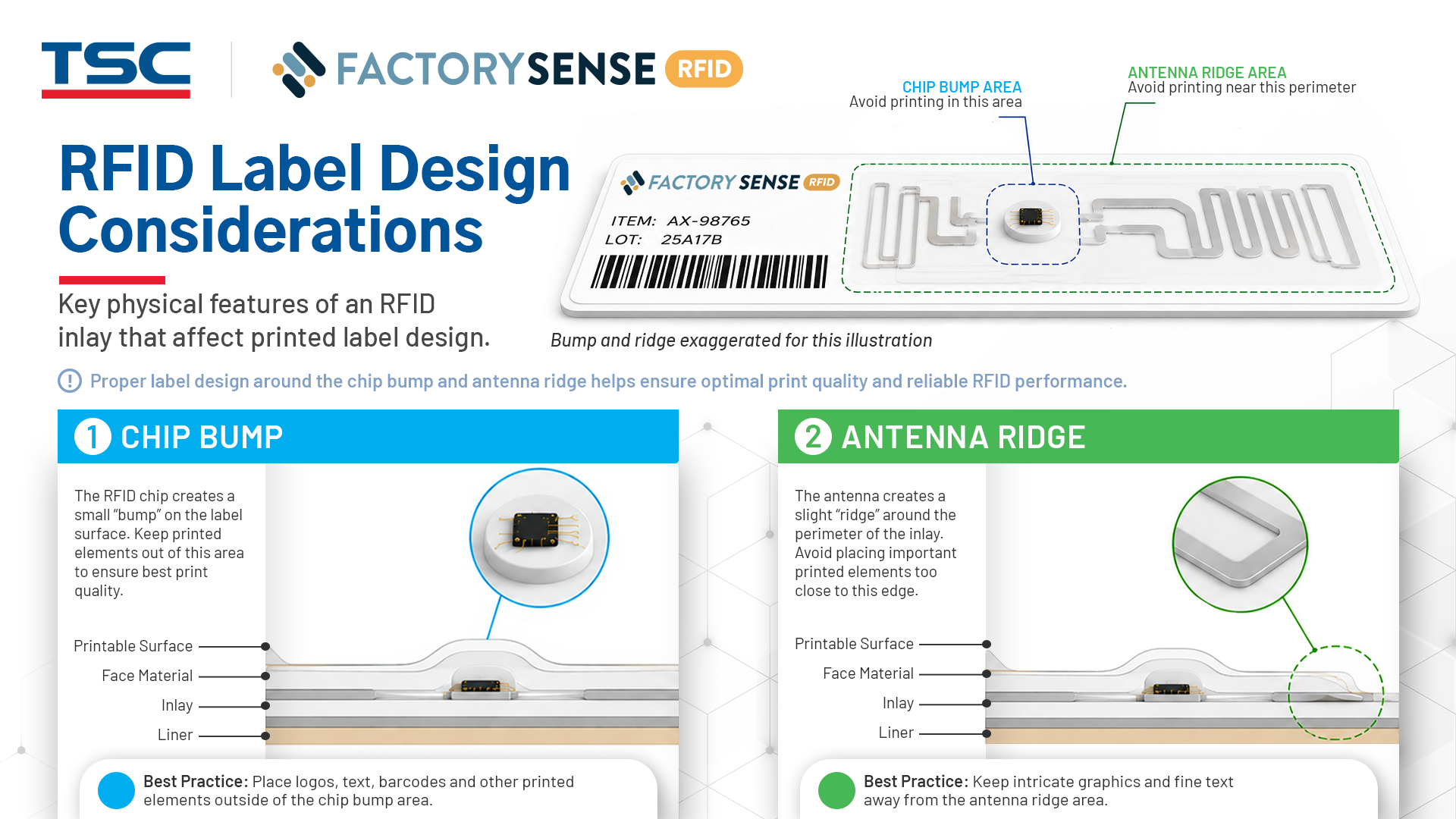
Before we get into encoding RFID tags, we must discuss two important factors in designing the printed elements of RFID-inlaid barcode labels. These are the chip bump and the antenna ridge.
Chip bump
Today’s RFID chips are extraordinarily small and thin: only fractions of a millimeter thick. However, they are not infinitely thin, so they produce a “bump” on the readable side of an RFID label. Be sure you know the location of the “bump” as you design your label, as it can affect the quality of the black (or whichever ribbon color you use) areas of your label. It is best to design labels so the “bump” falls within an area with no printing.
Antenna ridge
An RFID label is not just a tiny chip. Surrounding that chip and attached electrically is the antenna that reacts to RF signals. The antenna typically does not cover the entire bottom surface of the label material, and the antenna does have thickness, so it produces a “ridge” around its perimeter. While less abrupt than the chip, the antenna can adversely affect the label’s print quality, so you will want to design printed areas accordingly.
If you are using a high-resolution print head to print intricate graphic elements on RFID tags, it is best to place these graphics away from the chip bump or antenna ridge.
Encoding Basics
History: The Wild West of RFID
RFID has existed as a commercial offering for at least forty years. For much of this time, no standards dictated how the data must be written to a tag. Many early-adopter companies created their own encoding schemes, and the result were tags that could only be read using proprietary software. This was fine with early, vertically integrated applications, but as more actors started to create their own RFID solutions, and especially as large companies started mandating RFID, suppliers and customers needed standardized methods to encode and read tags. Imagine trying to create a solution that reads company A’s scheme, but receiving a pallet of goods encoded using company B’s – which you have never received before. Clearly, industry standards were needed.
RFID standards
There are two industry-standard numbering systems for RFID encoding: GS1 and ISO/IEC. Fortunately, these two organizations worked together to adopt the same “bit” in a tag as a distinguishing bit. If the “T-bit” is a 0, the tag is encoded using the GS1 system. If it is a 1, it is encoded using ISO/IEC.
However, within each numbering system there are multiple encoding schemes, and unfortunately proprietary encodings continue to exist. A primary reason for this is that RFID chips only encode a tiny amount of data – typically 96, 128, or 256 bits (12, 16, or 32 bytes or characters) and different companies want to store different information within that memory space.
You can imagine the problems with multiple companies using their own proprietary encoding schemes. The net: do yourself a favor and use standards-based encodings; resist the temptation to create proprietary encodings.
Popular Encoding Examples
Fortunately, several industry- and application-specific encodings have become so popular they are now de facto standards. It is beyond the scope of this article to go into detail about each, but here are some examples, brief descriptions, and links to documents that describe them.
| Encoding | Intended Use | Link |
|---|---|---|
| GS1 SGTIN-96 | Retailer mandates (Walmart, Dick’s Sporting Goods, Target, Macy’s, etc.) | https://ref.gs1.org/standards/tds/ |
| GS1 SGTIN+ | Pharmaceuticals and Medical Devices | https://ref.gs1.org/standards/tds/ |
| GS1 DSGTIN+ | Foodservice cases / cartons | https://ref.gs1.org/standards/tds/ |
| In the examples below, AFI means Application Family Identifier | ||
| ISO AFI 0xC1 | Airline baggage tags | Electronic Bag Tag (EBT) Implementation Guide |
| ISO AFI 0xAE | “Envelope/Wrapper” for closed-loop applications such as internal asset tracking | The RAIN Alliance-Issued CIN with Free-Form Encoding Schemes |
Serializing tags
There are generally two serial numbers associated with an RFID tag:
- Tag ID – uniquely identifies the individual RFID chip from every other chip in the world. Tag ID encoding is standardized, hard-coded to the tag chip and cannot be altered.
- Item ID – for GS1 encodings (T bit set to 0), this value is referred to as the EPC; for ISO/IEC encodings (T bit set to 1), this value is referred to as the UII. It is the serial number of the item to which the tag is attached. The “data owner” (i.e.: the manufacturer of the product to be tagged) of an RFID tag has complete control over and responsibility for this serial number. Since many companies use identical serial numbering schemes, such as CCYYDDXXXXXX where XXXXXX denotes each successive item manufactured on a date, simply reading the Item ID is not sufficient to identify a serial number as your serial number. Other identifiers, such as manufacturer ID, must also be taken into account.
Preventing tag tampering
As important as being able to identify unique items is ensuring that they are not changed by bad actors. A tag locking and/or authentication strategy must factor in these elements:
Access password
You can encode an access password into a chip and then lock one or more memory banks (see below). This password is required before the chip can be re-encoded.
Locking or “Permalocking”
During initial encoding or at any time thereafter, you can issue a command that locks areas of the chip (“banks”) or the entire chip, making it read-only.
Locking is reversible, if a future encoder has the access password.
“Permalocking” is not reversible. Once a tag is “permalocked,” it is read-only.
Killing a chip
You can render a chip unreadable, or “kill” it, two ways.
- Programmatically. Use a “kill” command to ensure the chip will not backscatter if activated, so cannot be read.
- Mechanically. Passing an RFID chip over a strong magnet, or subjecting it to a very strong RF field, will physically destroy the chip and/or its connection to its antenna. Physically mangling the chip/antenna matrix so the antenna mechanically disconnects from the chip has the same effect. Obviously, this is not reversible.
Encrypting and/or hiding tag data
You can encrypt the data area of a tag, making it unreadable to anyone who does not have the decryption key. Many encoding schemes that support encryption exist, so pick your favorite. Be mindful, however, that encryption schemes typically reduce the amount of data you can store within the tag's already finite memory capacity.
“Untraceable” functionality
Enabling “untraceable” in a tag chip essentially hides a tag or portion thereof from reading systems (the tag simply does not respond to read commands) unless a password is provided.
Digital Signature encodings
Tag encodings can also incorporate a Digital Signature to ensure data and/or tag owner (the party that encoded the tag) authenticity. Tag data and the data source are verifiable.
Validating tags
Creating proper encodings for a tag is only part of the work to ensure a good RFID label. Just as important is verifying two critical things:
- The encoding was done correctly.
- The correct tag was encoded.
The right printer can ensure both. Let’s take these two steps one at a time.
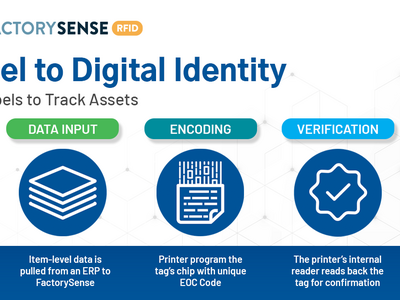
Proper encoding
All standards-based encoding devices support built-in encoding verification. Tag chips are required to return a signal of successful encoding or failure. (Whether companies that make encoding devices understand this or not is another question.)
Following this return signal from the tag chip, some companies behind encoding devices tout that they can also read back the tag value to ensure that it is correct. This can be done, but it is generally pointless because the standards already enforce this.
If the printer detects an encoding problem, it will attempt to reprogram the tag a user-definable number of times. If the tag will not program, the label is retracted and overstruck with a printed VOID pattern to alert employees that the tag is bad. Then, a new tag is printed with the same data and is again validated. Thus, you can be assured that if a non-VOIDed RFID label exits the printer, it can be read.
The right tag was encoded
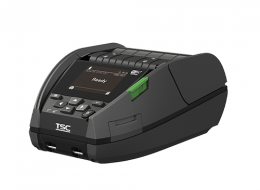
The real issue is whether the correct tag – not an adjacent tag – has been encoded. Only TSC RFID printers support a full suite of functionalities and algorithms to ensure that the correct tag has been encoded with the correct value. Collectively, these features are referred to as RTV™ - RFID Tag Validation.
Especially with small and short “pitch” tags, ensuring that the correct tag was encoded is challenging. TSC’s proprietary RTV™ suite provides the confidence and validation needed even with such challenging tags.
Again, TSC printers help prevent and detect bad encodings, in more than one way.
- Application of proper, standards-based encoding verification.
- TSC’s proprietary suite of RTV™ functionalities and algorithms to prevent erroneous encodings.
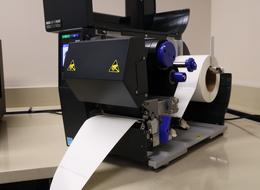
- Some TSC printers have two antennas: one before the print head and one after. The tag is programmed using the antenna print before the head, and as the tag exits the printer the antenna after the head ensures that the encoding matches the data sent to the printer. This reduces incorrect encoding risks to virtually nil.
- As a TSC partner, FactorySense helps customers ensure RFID tags, label design, printer configuration, and encoding strategies align with real operational environments and business processes. This includes selecting the right tag types, designing labels that account for chip bump and antenna placement, configuring printer encoding and validation settings, and testing tags within actual workflows. By combining practical RFID consulting and system integration expertise with TSC’s printer technology, FactorySense helps ensure properly encoded RFID labels support reliable, scalable tracking across manufacturing and supply chain operations.
Conclusion
Standards are important to ensure that RFID projects work not just for one company but for the entire supply chain. Adopting an industry-recognized encoding scheme ensures wide compatibility. Protecting tags by locking, encrypting, and once their life is over, destroying them helps maintain the integrity of your brand. And finally, using the right printers ensures that only the intended tag is encoded, and that it is encoded correctly.