






























Closing the Visibility Gap at the Dock Door: How Automated RFID Is Transforming Inbound & Outbound Logistics
Distribution centers and 3PL operations run on a simple promise: what arrives at the dock door matches what was expected, and what leaves matches what the customer ordered. In practice, that promise breaks down more often than operators would like — and the cost shows up in chargebacks, inventory write-offs, and dock teams stretched thin just to keep pace.
The Problem: Limited Visibility, Inefficient Dock Operations
Most dock operations still run on trust. When a carton or pallet crosses the dock, the assumption is that its contents match what the label, packing list, or order says should be inside. A barcode scan confirms that a box was handled, not what the box actually contains, and at the dock there is typically no automated way to verify the physical contents of an inbound or outbound shipment against what is expected. The result is a familiar set of symptoms:
- No real-time visibility into the actual goods physically moving through the dock
- No automated, item-level verification of actual shipment contents against the expected shipment or order
- Disconnected systems between what's physically moving and what the WMS or ERP thinks is moving
- Slower throughput and longer dock turnaround times as volume grows
The business impact compounds quickly: incorrect shipments trigger customer disputes and chargebacks, inventory counts drift from reality, and scaling operations means scaling headcount right along with it.
What This Actually Costs
Consider a straightforward outbound order. The customer ordered:
- 500 Blue T-shirts, size M
- 350 Red T-shirts, size L
The shipment that leaves the dock contains:
- 450 Blue T-shirts, size M
- 400 Red T-shirts, size L
Every carton may have been handled and labeled correctly, but the contents don’t match the order, and nothing at the dock catches the discrepancy before the trailer departs. The customer ends up short on one item and over on another. What follows is a chain of costs: customer claims and chargebacks, added transportation or return shipping, manual investigation and reconciliation, inventory discrepancies on both ends, and extra labor to correct the shipment.
This is the gap automated RFID at the dock is built to close: replacing trust with verification of what is inside the box.
The Solution: Automated Inbound & Outbound RFID
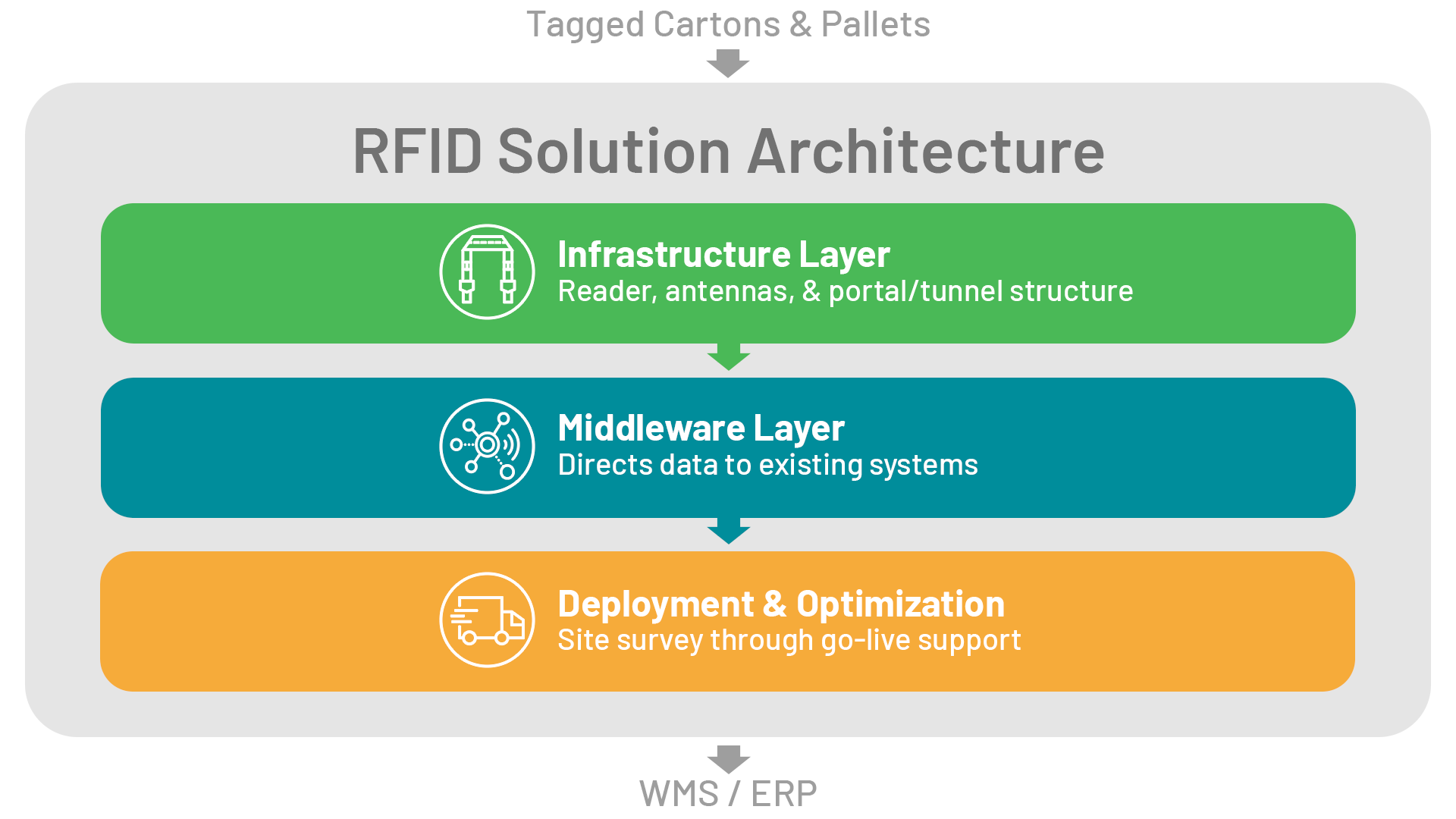
An automated inbound and outbound solution brings together three layers into a single, coordinated system:
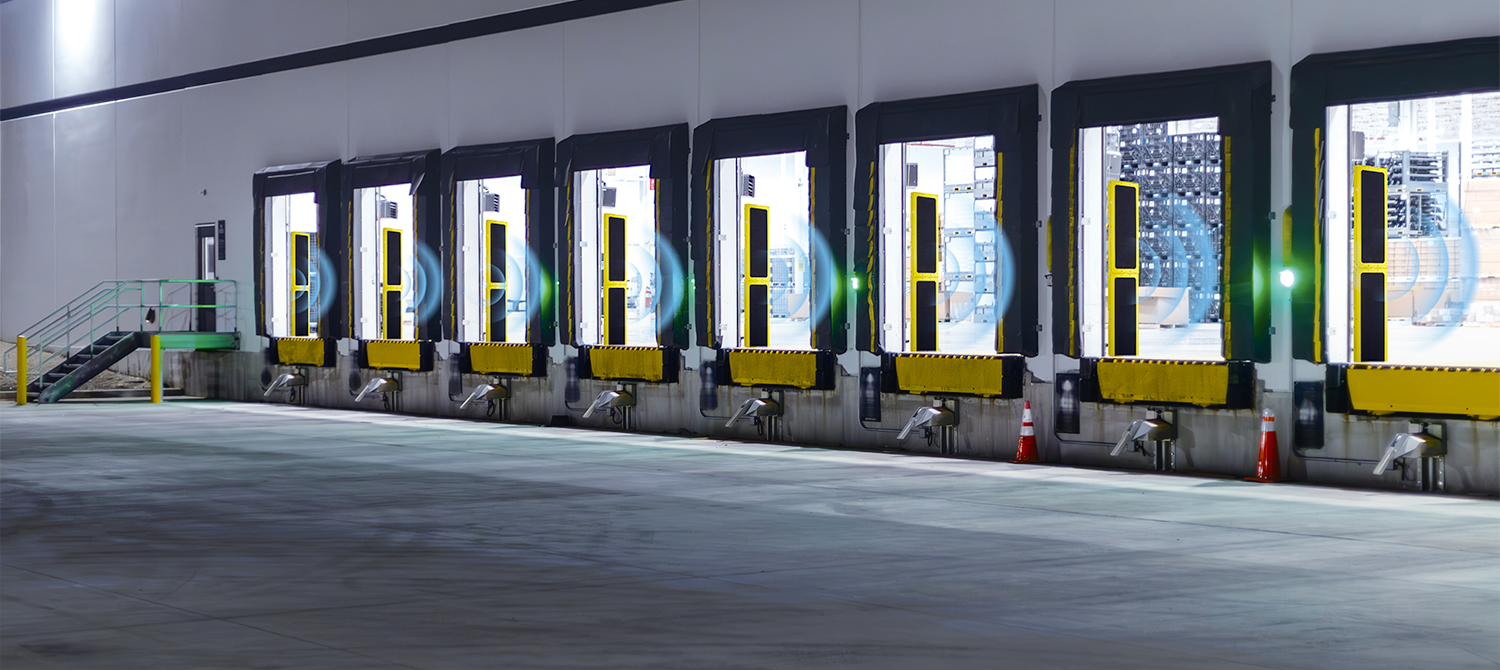
- RFID Infrastructure Layer — A complete fixed RFID solution integrating the reader, antennas, and portal or tunnel structure, engineered together to create a reliable read zone for automated identification and verification of tagged goods at the dock. It can take the form of a dock portal, tunnel, or chamber, depending on the operation.
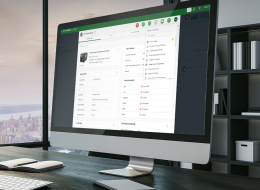
- Middleware Layer — Middleware applies rules-based processing to RFID reads and acts as the data connection between the reader and the customer’s existing systems, directing that data to the server, WMS, or ERP where it’s needed.
- Deployment & Optimization — A proven RF deployment and sustainment playbook ensures dock-level reliability from initial site survey through go-live.
In practice, tagged pallets and cartons pass through an RFID portal or tunnel, where a fixed reader such as TSC’s FR901 reads every tag automatically, with no operator scan. The middleware layer passes that data into existing WMS and ERP systems, so the actual contents of a shipment can be verified against the order before it ships. Instead of trusting what’s inside the box, operations teams know what’s inside the box.
Read accuracy holds at 99%+ at 600–1,200 cases per hour per portal — a meaningful jump from manual barcode throughput, and one that scales from a single dock door to global, multi-site operations.
What Changes on the Ground
For dock supervisors, inventory control managers, and operations leaders, the shift shows up in a few concrete ways:
- Hands-free capture. Cases and pallets are read automatically as they move through the portal — no operator scanning, no missed reads, no double counts.
- Real-time verification. What’s physically moving through the dock is checked against the expected shipment or order contents as it happens, not after the fact.
- Exceptions caught before the trailer leaves. Short-ships, over-ships, and wrong-item errors are flagged at the gate instead of discovered by the customer.
- Automatic system-of-record updates. Dock events push directly into WMS, ERP, and TMS, eliminating manual data entry and the errors that come with it.
- An audit trail that builds itself. Every event is timestamped and traceable, ready for retailer, regulator, or customer disputes without reconstructing paperwork.
The Numbers
Organizations that have automated inbound and outbound dock operations typically see:
- 30–50% fewer labor hours on receiving and shipping, with 40–70% less time spent on dock-door scanning
- 95–99%+ read accuracy at the portal, with 20–40% faster inbound receiving cycle times
- 60–90% fewer mis-shipments, including a 40–70% reduction in mis-ship and short-ship chargebacks
- 10x faster verification than barcode scanning, sustaining 600–1,200 cases per hour per dock portal
- ROI payback in under six months, with a 2–7% revenue uplift tied to improved inventory accuracy
Beyond the labor and error-rate improvements, the compliance picture changes too: automatic, timestamped audit trails reduce exposure to SLA penalties and regulatory fines and speed up customer dispute resolution when questions do come up.
Why It Works as One System, Not a Patchwork
The operational gains depend on the pieces working together rather than being bolted on after the fact. An integrated approach pairs industrial-grade RFID hardware built for 24/7 conditions with middleware designed to work with it, from RF site design through exception management and system integration. For manufacturing and other automated environments, the FR901 is also compatible with leading PLC hardware and software.
On the standards side, support for RAIN UHF Gen2v3, along with Impinj Gen2X features, keeps the reader aligned with current tag technology, while communication protocols including LLRP, MQTT, REST API, and EtherNet/IP govern how read data reaches its destination. From there, TSC’s middleware partners handle integration with major WMS and ERP platforms such as SAP, Oracle, Manhattan, and Blue Yonder, so the integration burden doesn’t fall on the operations team.
That combination — one integrated hardware stack, partner-delivered middleware, and a single proven deployment playbook — is what separates a pilot that works on a single dock door from a solution that scales across a network.
Where to Start
Automating inbound and outbound dock operations doesn't require a full-facility overhaul on day one. A single-door pilot is enough to validate read accuracy, throughput, and integration with existing WMS or ERP systems before scaling further. For operations still relying on manual barcode scanning and paperwork-based verification, the dock door is often the highest-leverage place to start closing the visibility gap — and the fastest way to see whether the numbers above hold true for your own operation.